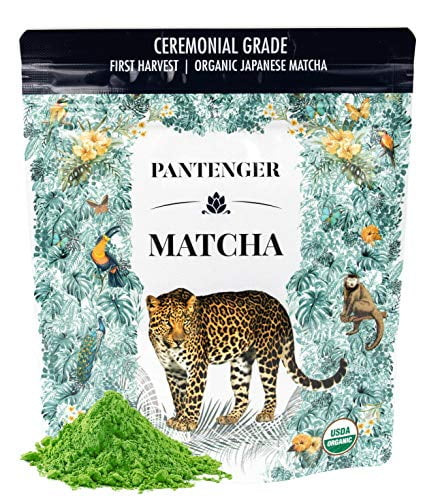
Pantenger Matcha Ceremonial Grade is the highest grade of matcha available in Japan and is used for the Japanese Tea Ceremony. It is organically grown in Kagoshima Prefecture by a ninth-generation family-owned tea estate that has accumulated over 250 years of artisan expertise.
The tea leaves are grown under shade for three weeks before the first flush of spring, leaves are hand-picked, then powdered using traditional granite stone mills. The “First Flush of Spring” is the first harvest of the year, and the leaves contain three times more L-theanine than the second or summer harvest. Pantenger Matcha contains high levels of antioxidants and amino acids.
The 20 days of shade force the plant to overproduce chlorophyll, which is what makes the tea a vibrant emerald green. Low-quality matcha is pale and yellowish. Pantenger Matcha is milled using granite stone mills. The result is a silky texture.
The L-theanine produced by an excess of chlorophyll gives Pantenger Matcha a sweet taste and aroma of fresh grass. Low-quality matcha tends to be bitter and astringent.
INGREDIENTS: JAPANESE ORGANIC MATCHA GREEN TEA.
USDA Organic certified by OTCO.
Kosher certified by OU.
Non-GMO.
Gluten Free.
Vegan.
Brewing a perfect cup:
A great cup of tea requires three elements: great tea, water and a tea master (you). Use the correct dose: 1/3 of a teaspoon is enough to start with. A larger quantity will make your matcha bitter. A well prepared cup of matcha is creamy and sweet. Water: add a little bit of water and whisk until any lumps dissolve (matcha particles are extremely small). Add more water up to 3 FL OZ and keep whisking making W’s, not circles, until it is frothy.
Using the right water temperature (160ºF to 170ºF) will extract the matcha sweet soluble components such as L-theanine. Using a higher temperature will bring a high amount of the bitter and astringent components to your cup such as caffeine and catechins.
The traditional Japanese Matcha bowl, whisk and spoon are desirable but not mandatory to start. If you enjoy Matcha you can then obtain them.
The tea leaves are grown under shade for three weeks before the first flush of spring, leaves are hand-picked, then powdered using traditional granite stone mills. The “First Flush of Spring” is the first harvest of the year, and the leaves contain three times more L-theanine than the second or summer harvest. Pantenger Matcha contains high levels of antioxidants and amino acids.
The 20 days of shade force the plant to overproduce chlorophyll, which is what makes the tea a vibrant emerald green. Low-quality matcha is pale and yellowish. Pantenger Matcha is milled using granite stone mills. The result is a silky texture.
The L-theanine produced by an excess of chlorophyll gives Pantenger Matcha a sweet taste and aroma of fresh grass. Low-quality matcha tends to be bitter and astringent.
INGREDIENTS: JAPANESE ORGANIC MATCHA GREEN TEA.
USDA Organic certified by OTCO.
Kosher certified by OU.
Non-GMO.
Gluten Free.
Vegan.
Brewing a perfect cup:
A great cup of tea requires three elements: great tea, water and a tea master (you). Use the correct dose: 1/3 of a teaspoon is enough to start with. A larger quantity will make your matcha bitter. A well prepared cup of matcha is creamy and sweet. Water: add a little bit of water and whisk until any lumps dissolve (matcha particles are extremely small). Add more water up to 3 FL OZ and keep whisking making W’s, not circles, until it is frothy.
Using the right water temperature (160ºF to 170ºF) will extract the matcha sweet soluble components such as L-theanine. Using a higher temperature will bring a high amount of the bitter and astringent components to your cup such as caffeine and catechins.
The traditional Japanese Matcha bowl, whisk and spoon are desirable but not mandatory to start. If you enjoy Matcha you can then obtain them.